Taking Stock of Public Perceptions of the United Nations.

Has the global public lost trust in the UN?
The short answer is no, but there are mixed signals. There is also a wealth of new data to draw on, with two new cross-national surveys on public perceptions of the UN released within the past week (a 34-country survey by the Rockefeller Foundation and Focaldata and a 20-country survey by the UN Foundation).
Overall, these and other recent cross-national surveys show that views of the UN remain largely positive on a global scale. Yet there is variation over time, between countries, and within countries.
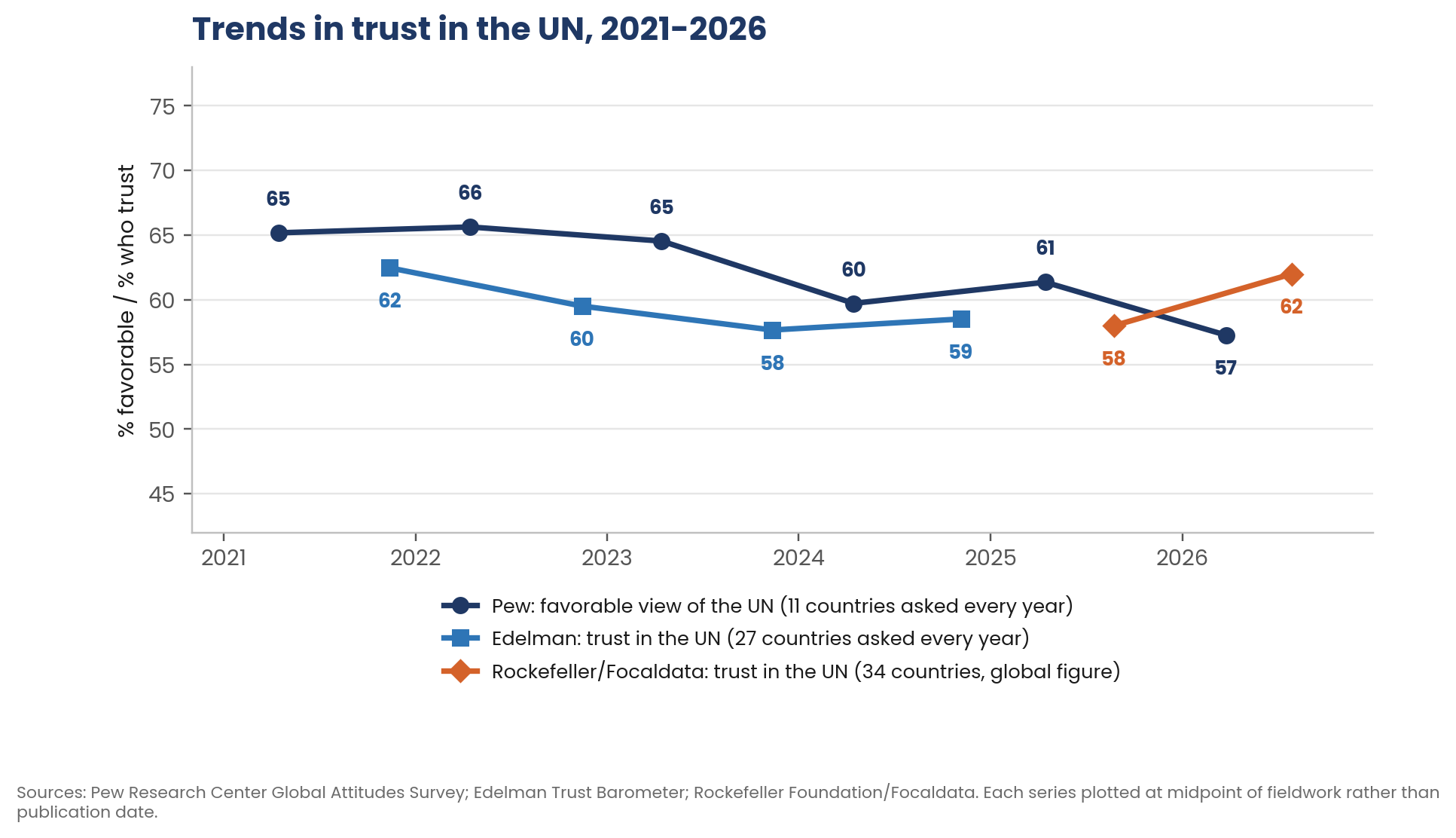
Over time, trust in the UN has trended downward, but only slightly—and there may be signs of a rebound. Until recently, trust in the UN had gradually eroded over the course of several decades, but there was little evidence of a major, widespread drop. Beginning around 2022, however, surveys began to register a clearer deterioration in public opinion.
Over the past year, surveys have diverged. After registering an uptick in favorable views of the UN in 2025, Pew’s annual Global Attitudes Survey showed an overall drop in 2026. While favorable views still predominated (a median of 55% favorable to 37% unfavorable across the 37 countries surveyed), 10 countries registered a statistically significant drop in favorability since the previous year, and only one registered an increase.
A different picture emerges from the new 2026 survey by the Rockefeller Foundation and Focaldata, which found an overall increase in trust in the UN since the inaugural survey in 2025 (from 58% to 62% across the 34 countries surveyed). Various factors could account for this divergence, including question wording (favorability vs. trust), survey methodology (telephone and face-to-face vs. online panel), timing (February–May vs. July–August), or the selection of countries.
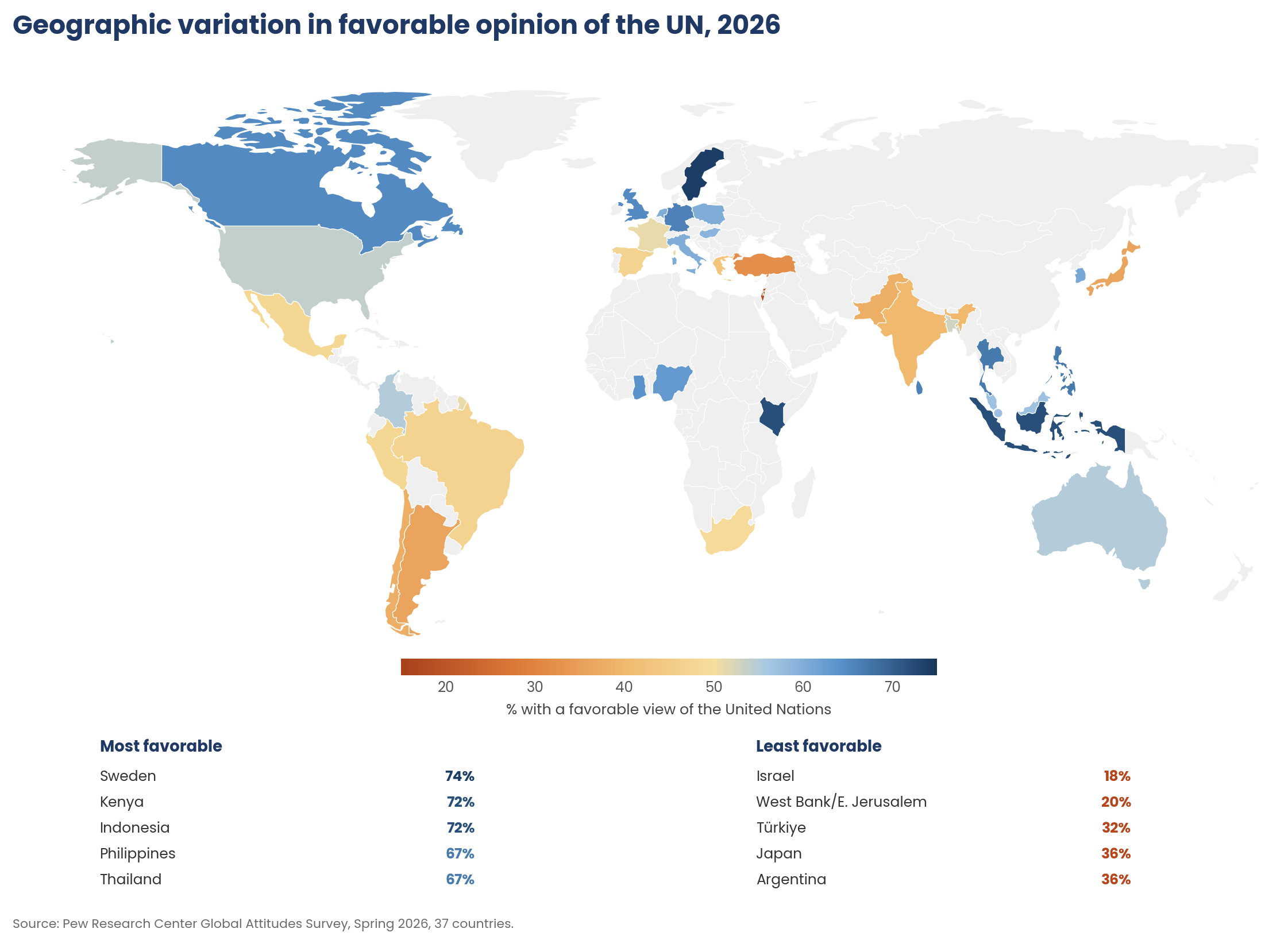
There is also significant variation in public perceptions of the UN between countries. Surveys consistently show that perceptions are more positive in Northern Europe, Southeast Asia, and parts of sub-Saharan Africa and more negative in much of the Middle East and North Africa and Latin America. More broadly, perceptions of the UN are significantly more positive in developing than wealthier countries (with 57% vs. 46% expressing comfort with the UN playing a leading role in world affairs) and in the Global South than the Global North (with 65% vs. 44% trusting the UN).
Within countries, the UN’s favorability varies depending on factors such as age and ideology. Young adults tend to be more favorable toward the UN than older adults. Political ideology is also a strong driver of perceptions of the UN, with higher skepticism among populist voters, especially on the far right. Partisan differences are particularly strong in the US, where views of the UN have become increasingly polarized between Democrats and Republicans.
Overall, these and other recent cross-national surveys show that views of the UN remain largely positive on a global scale. Yet there is variation over time, between countries, and within countries.
Over time, trust in the UN has trended downward, but only slightly—and there may be signs of a rebound. Until recently, trust in the UN had gradually eroded over the course of several decades, but there was little evidence of a major, widespread drop. Beginning around 2022, however, surveys began to register a clearer deterioration in public opinion.
Over the past year, surveys have diverged. After registering an uptick in favorable views of the UN in 2025, Pew’s annual Global Attitudes Survey showed an overall drop in 2026. While favorable views still predominated (a median of 55% favorable to 37% unfavorable across the 37 countries surveyed), 10 countries registered a statistically significant drop in favorability since the previous year, and only one registered an increase.
A different picture emerges from the new 2026 survey by the Rockefeller Foundation and Focaldata, which found an overall increase in trust in the UN since the inaugural survey in 2025 (from 58% to 62% across the 34 countries surveyed). Various factors could account for this divergence, including question wording (favorability vs. trust), survey methodology (telephone and face-to-face vs. online panel), timing (February–May vs. July–August), or the selection of countries.
There is also significant variation in public perceptions of the UN between countries. Surveys consistently show that perceptions are more positive in Northern Europe, Southeast Asia, and parts of sub-Saharan Africa and more negative in much of the Middle East and North Africa and Latin America. More broadly, perceptions of the UN are significantly more positive in developing than wealthier countries (with 57% vs. 46% expressing comfort with the UN playing a leading role in world affairs) and in the Global South than the Global North (with 65% vs. 44% trusting the UN).
Within countries, the UN’s favorability varies depending on factors such as age and ideology. Young adults tend to be more favorable toward the UN than older adults. Political ideology is also a strong driver of perceptions of the UN, with higher skepticism among populist voters, especially on the far right. Partisan differences are particularly strong in the US, where views of the UN have become increasingly polarized between Democrats and Republicans.


Comments
Post a Comment